Most businesses don't have an operating system
The difference between a business you designed and one you simply ended up with, and why more software rarely closes the gap.
Most businesses don't have an operating system.
That probably sounds like an odd thing to say, especially when almost every business already has accounting software, a CRM, an ecommerce platform, a handful of spreadsheets and more subscriptions than anyone can remember paying for.
What I mean is something slightly different.
Most businesses have accumulated ways of working over time, rather than intentionally designing how the business itself should operate. Every new customer, employee, product, supplier and software purchase nudges things in a slightly different direction. Each individual decision makes sense at the time, but after a few years it's easy to end up with a business that feels harder to run than it should.
I've seen this in businesses with ten employees and businesses with hundreds. It isn't usually caused by bad people or bad software. More often, it's because nobody has ever had the time to step back and ask a deceptively simple question.
The shortcut that always looks rational
A few years back, inside a much larger, multisite business, I used to notice it just by walking between departments. I'd pass a desk and see someone halfway through building a spreadsheet, or carefully reformatting a document, or working in some tool I didn't recognise that had quietly appeared on a company card. Almost every time, the information they were wrestling with already existed somewhere else in the business. The data wasn't missing. Getting to it properly just meant raising a request, waiting for it to be prioritised, and watching it slide down someone else's list behind ten other things that also mattered.
So they did the reasonable thing and decided it would be quicker to build it themselves. And on the day, it usually was. That's the part that's easy to miss. The shortcut was the rational choice at the time. The cost only turned up later, when a figure that should have matched didn't, or a decision got made on numbers that had quietly drifted out of sync, and someone lost an afternoon working out why two versions of the same truth disagreed. The friction never actually went away. It just moved somewhere harder to see and waited.
Which brings me to a question I think is worth putting to almost any established business.
If we were starting this business today, would we build it to work like this?
That's a surprisingly uncomfortable question, because the honest answer is often "probably not".
How the drift happens
Somewhere along the way, information started being entered twice because it was quicker than fixing the process. A spreadsheet appeared because the software couldn't quite do what somebody needed. Reports were emailed around because that was easier than giving everyone access to the same information. None of these decisions were wrong. They were practical responses to the situation at the time.
The difficulty is that businesses rarely stand still. They grow, change and adapt, but those small decisions stay behind. Over time they become "the way we do things", even if nobody can remember why.
The problem usually isn't the software
That's one of the reasons I'm always slightly sceptical when someone says they're looking for a new piece of software to solve an operational problem. Sometimes a new platform is exactly what's needed, but it's remarkable how often the software isn't really the issue.
Imagine buying a bigger filing cabinet because you can't find your paperwork. You certainly have more storage afterwards, but unless somebody also decides how the paperwork should be organised, you'll probably end up with a larger filing cabinet that's just as frustrating to use.
Business software can be a bit like that. Every platform promises to solve a particular problem, but very few of them can decide how your business should actually work. That's your job.
It changes the conversation, too. "What software do we need?" sends you looking at products. "What are we actually trying to achieve, and what is making that harder than it should be?" sends you looking at the business itself, and only reaches for a product once it knows what it is solving. Those are very different places to start.
Somewhere in all of that I settled on a belief I keep coming back to. Businesses become complicated on their own. Simplicity is the part you have to design on purpose.
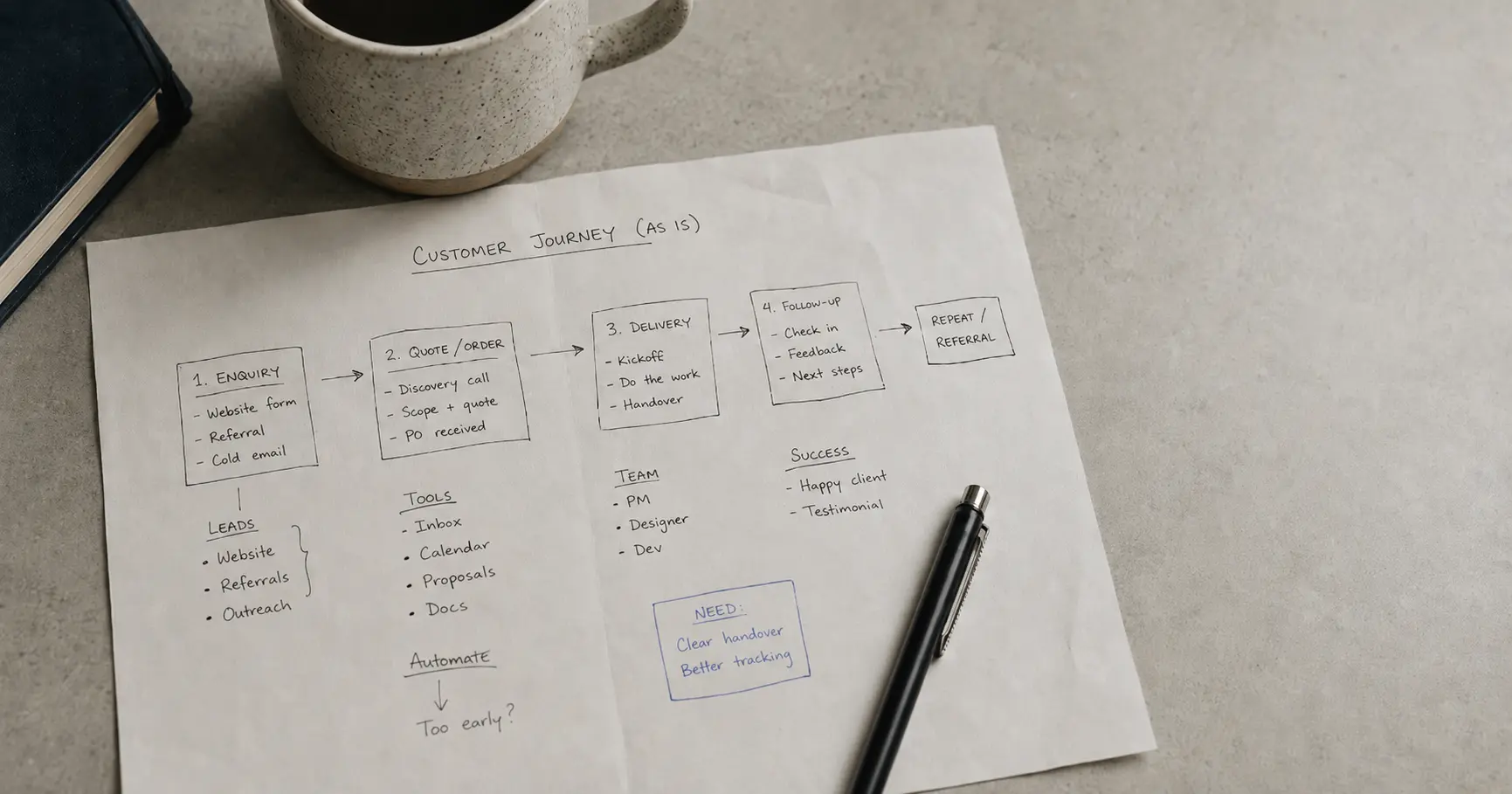
Start with a blank sheet of paper
If you're not sure where to begin, try something deliberately low-tech.
Take a blank sheet of paper and follow a customer through your business. Start with the first enquiry and don't stop until they've paid, received what they bought and, ideally, come back again. Don't think about departments or software yet. Just map what actually happens.
Once you've done that, look for the places where information is copied, somebody has to ask another person for an update, or the same decision is made repeatedly because the process doesn't make it obvious what should happen next. Those moments are usually where the friction lives.
Some of them might point towards better software. Others might disappear entirely with a small change to the way the business operates. Either way, you'll have a much clearer idea of the problem you're trying to solve before you start looking for technology to solve it.
What a business operating system actually is
That's what I mean by a business operating system.
It isn't another platform you can buy. It's the way your people, processes, information and technology work together. Good software supports that operating system, but it doesn't replace it.
The businesses that seem to grow with the least drama aren't necessarily the ones with the biggest technology budgets or the newest tools. They're usually the ones that have taken the time to design how they want the business to work, and then chosen technology that supports that design rather than defining it.
Technology changes constantly. Good operating principles tend to last a lot longer. If there's one thing I'd want a founder to hold onto, it's that businesses become complicated on their own, and simplicity is the part you have to design on purpose.