Measurement shouldn't stop when the campaign leaves the screen
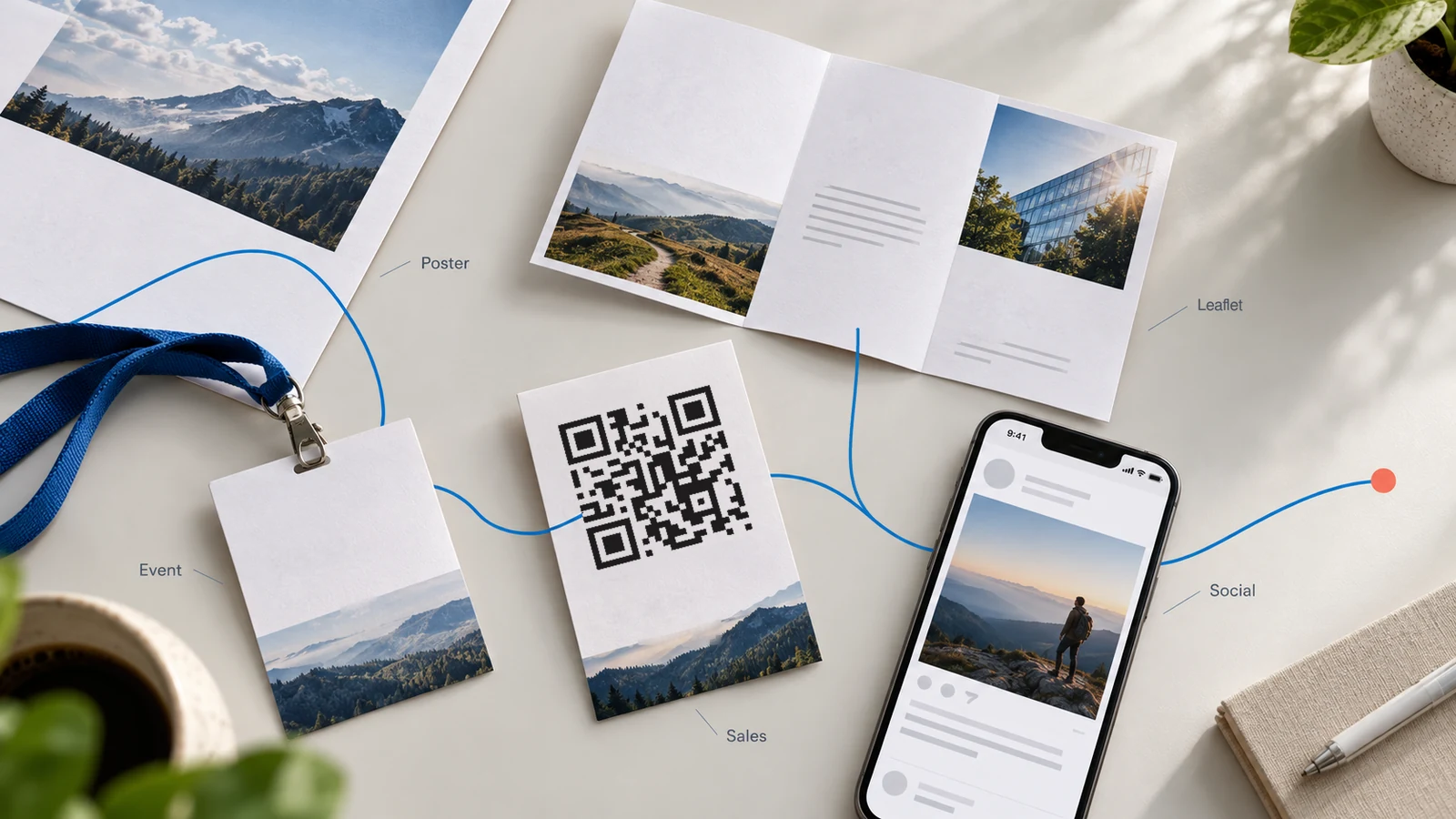
A campaign can start with a LinkedIn post, continue on a printed card at an event, get passed to somebody else, be scanned days later, land on a website and eventually lead to an enquiry or sale. By the time anyone sits down to review it, that journey has usually been split into a social report, an email report, website analytics and, if somebody planned for it, a QR scan count. Each one tells part of the story, and none of them was set up to tell it together.
In August I wrote about what working with Tiger Darts taught us about customers who don't stay online. This follows on from it. Once you accept that people move between physical and digital, how should the measurement around a campaign be organised so the whole thing can actually be reviewed?
We've become very good at measuring the digital middle of a journey. Page views, clicks, referrers, conversions and campaign parameters are all familiar. When the journey moves into something physical, the context usually gets thinner. A scan may still be measurable, but why that QR code existed, where it was used, which activity it belonged to and how it relates to everything else can disappear surprisingly quickly. If the customer journey crosses media, the measurement model has to cross them too.
The medium is not the journey
Customers don't think in the channel boundaries that marketing systems do. They might see something on social, visit a website, come across the business again at an exhibition, take away a printed card and scan it 3 days later. Another person might be handed that card without ever seeing the original post, and somebody else might go straight from an email to the same destination. Those are different routes, but they can all belong to the same initiative.
Reporting gets awkward because the tools start with the medium. Social has one report and email has another. Website analytics starts once somebody arrives. Print may have a QR count, if it has any measurement at all, and event activity might be reduced to the leads collected on the day. Each view is useful on its own, but the campaign has been split apart before anyone has tried to understand it.
The interaction needs context
A QR code isn't a measurement strategy. Neither is a short link. Both are useful because they can carry a measurable interaction from one place to another, and what makes that interaction useful later is the context attached to it.
A QR code on an exhibition stand and a QR code on packaging might lead to the same page, but they're different pieces of activity. A link in a LinkedIn post and a link in an email can share a destination while reaching people in very different circumstances. If they all collapse into the same destination traffic, you've kept the visit and lost part of the reason it happened.
So it's worth deciding what an interaction represents when you create it: which initiative it belongs to, which medium it's being used in, whether it's attached to a physical asset, whether placement matters and whether it'll be reused or only used once. The customer shouldn't have to answer any of that. The structure sits behind the experience.
Measurement is not the same as perfect attribution
That structure still needs an honest boundary around what the data can tell you. I covered the attribution problem in the August piece, so I won't repeat it here. For this article, the useful rule is simpler: keep the evidence attached to the measurable routes you can see and leave everything else unclaimed.
A scan from a printed item is observable, and so is a click from a particular campaign link. The relationship between that interaction and the initiative it belongs to can be recorded when it's created instead of guessed at later. I'd much rather have honest evidence about the routes I can see than a confident story about the ones I can't.
Group the work around the objective
Imagine a product launch with a LinkedIn post, an email, printed material at an event, a QR code on a leave-behind card and a follow-up link shared by the sales team. Each of those touchpoints should keep its own source detail. The printed card should keep its event source even if somebody first heard about the launch on LinkedIn, while the email should remain a separate source from a scan at an exhibition.
They should still be reviewable as parts of the same launch, though, which means organising the measurement around the business activity instead of the mechanism used to reach people. You want to ask how the launch performed overall, then move down into the individual media and touchpoints to see where the engagement came from. Otherwise whoever reviews performance has to rebuild the campaign by hand from 5 different reports before they can start learning anything from it.
Measurement should change the next decision
What you want from all this is a better idea of what to do differently next time. Take a local event promoted with banners, posters and leaflets across 20 locations. Every piece could send people to the same destination, but if every placement shares one generic QR route, the organiser only learns that the campaign generated some activity.
If each placement keeps its own measurable identity, the organiser can compare which locations and formats produced observable engagement while still reviewing the whole thing as one campaign. That might mean fewer leaflets in one area, more posters somewhere else, a different split between formats, or no longer paying for a placement that repeatedly produces nothing measurable. That's far more useful than knowing how many scans the campaign got.
Downstream conversion or value data can make that comparison commercially stronger. Without it, the result is still useful as evidence of observable engagement, but it should stay labelled that way rather than being treated as proof of sales or total campaign impact.
There's more to Bytes than the first click or scan
At first glance, Bytes can look quite simple. A link or QR code gives someone a measurable route from one place to another, and that alone can be useful. Once those interactions sit alongside Offline Engagement, Activity Groups and Analytics, you can keep the source context, group related activity around the same campaign and compare engagement across physical and digital touchpoints.
Offline Engagement lets a physical touchpoint stay explicitly physical instead of becoming an anonymous website visit. Activity Groups bring related interactions together around a campaign, event or programme while each one keeps its own identity. That gives you a much wider view of the journey behind the individual click or scan, and often exposes questions you wouldn't have known to ask from the destination traffic alone.
A simple way to review a campaign
Before launching the next campaign, it's worth asking 5 questions. They force the measurement structure to be decided before the data arrives.
-
What are we actually trying to measure?
Start with the initiative or outcome, then map the channels that contribute to it. -
Which physical and digital touchpoints are part of it?
Include every place people can come across the campaign, including physical touchpoints and systems without their own analytics. -
Can each observable interaction keep enough source context?
If 3 different materials all point to one page, decide whether you still need to know which one was used. -
What can we genuinely observe, and what would only be an inference?
Keep that boundary clear before the numbers arrive. -
Can we review the initiative as a whole without flattening the individual sources?
You want one campaign view with useful detail underneath it, rather than one big number that hides where anything happened.
None of that needs more tracking for the sake of it. In most cases it just means being more deliberate with the interactions that already exist.
See what your campaign is actually doing
If your campaigns already move between social, email, print, events and other physical touchpoints, you're probably creating more measurable signals than your existing reports show. Bytes helps keep those interactions identifiable, group related activity around the same initiative and compare where engagement is actually coming from.
That can start very simply. Give the important touchpoints in your next campaign their own measurable identity, keep the source context attached to them and review the results together. You can see which materials, placements and channels are getting a response, where activity continues after the original campaign has finished, and where the next change to your spend or approach might make the biggest difference.
If you want to put some numbers around that first, try the Bytes Value Calculator. Add your own marketing spend, offline activity or printed volumes and it will give you a working estimate of the value that better measurement and destination control could expose. You may already be spending money in places where a relatively small amount of additional context would make the next decision much easier.
Then try Bytes on something real. Use it for the next event, print run or mixed-media campaign and see what the activity actually tells you. If you're dealing with something more complicated, talk to us. We can help map the journey, work out which interactions are worth measuring and structure the campaign so the useful context survives from one medium to the next.
You might be surprised by what you find.