You learn a lot more about measurement when customers don't stay online
Digital analytics can tell you an extraordinary amount about what somebody does on a website. Then they leave it.
That sounds obvious, but it remains a large blind spot in how many businesses think about measurement. Customers don't stay inside one channel. They see something on social media, visit a website, walk into a shop or workshop, pick something up, scan a QR code, share a link with someone else, come back a week later and perhaps interact with a different product entirely. From their point of view that is one relationship with a business. From an analytics point of view it can look like several unrelated journeys.
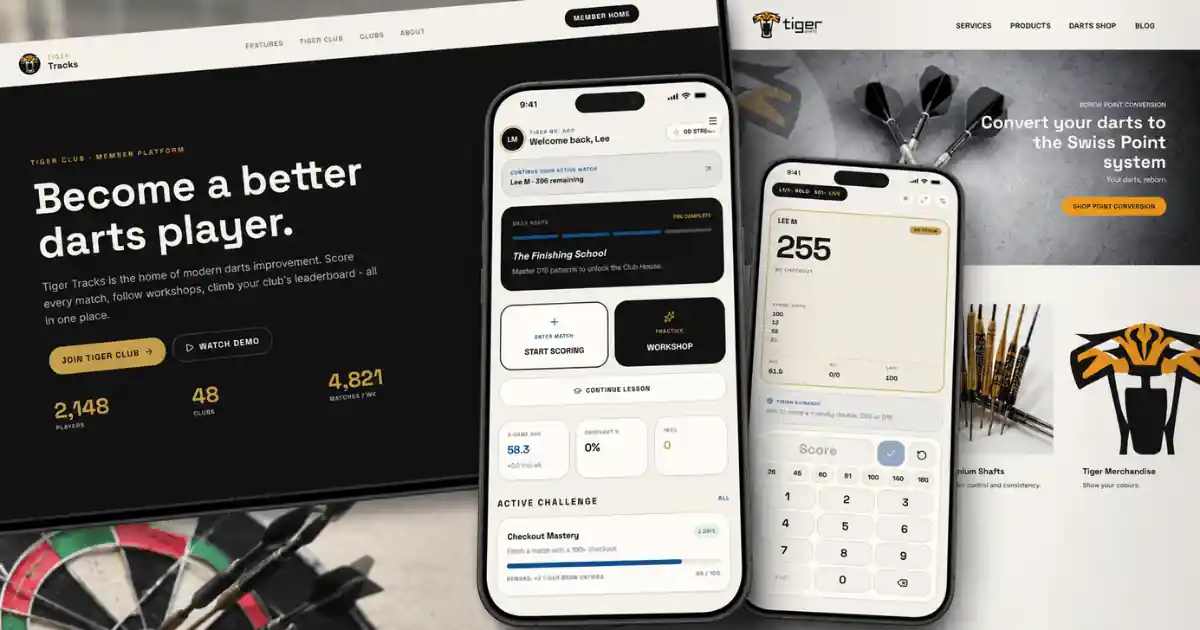
We have seen a lot of this while working with Tiger Darts, which is one of the reasons Tiger has been a useful part of the Bytes beta.
A real customer journey is rarely a funnel
Tiger Darts is a good environment for testing this because the business doesn't exist purely online. There is ecommerce, social activity, a physical workshop, customers visiting in person, events, printed materials and now digital products such as Tiger Tracks. Someone might first discover Tiger through Instagram. Another person might be handed something in the workshop. Someone else might scan a QR code at an event or follow a link shared by another player. Reducing all of that to a tidy funnel misses how people actually behave.
It is also where conventional web analytics starts to lose the story. You can know a great deal about a visitor once they arrive on a website, but much less about what happened before they got there or what happens when the journey moves back into the physical world. That doesn't make offline activity impossible to measure. It means we have to be more deliberate about how we connect it.
Why we built Bytes
Bytes started from a simple idea: links and QR codes shouldn't just move someone from one place to another. They can also tell you something useful about how they got there. A short link used on LinkedIn can be different from one used in an email. A QR code on a workshop card can be different from one used at an event. Different pieces of printed material can carry their own links while still being grouped as part of the same wider activity. That gives us a way to join up journeys that would otherwise disappear into a generic website visit.
That doesn't mean everything can be traced. If somebody sees a poster on Monday, talks to a friend on Wednesday and types the web address into their browser on Friday, no sensible piece of software should claim to know what caused that decision. Where somebody does scan a code or follow a link, though, that route stays attached to them, so alongside site analytics we can see the sale it led to instead of filing it under direct traffic and quietly assuming the physical activity did nothing. We can't account for every impression, but the journeys that were tracked no longer disappear.
What Tiger has helped us find
There is a real difference between developing an analytics product against a set of demonstration links and seeing what happens when a business actually uses it. We can use Bytes around website activity, campaigns, social posts, QR codes and printed materials, and increasingly around parts of the Tiger Tracks experience. That gives Tiger a consistent way to understand where people arrive from and how different activity performs, without turning Tracks itself into an analytics product. The measurement sits around the journey rather than forcing every system involved to measure everything else.
The same approach can then follow a customer across different environments. A QR code printed on something handed over in the workshop can lead into a digital journey. A link inside a digital product can take someone somewhere else. An event can generate activity days after everyone has packed up and gone home. Bytes gives those touchpoints a common measurement layer.
Measuring the physical side
For years digital had an advantage because measurement was built into the medium. Clicks were measurable, pages were measurable, campaigns could carry parameters and conversion paths could be analysed. Print, packaging, exhibitions and signage were often treated differently. Something was printed, distributed or displayed, and its effect became much harder to see.
We have been thinking about this for a while, including around measurable print and physical-to-digital engagement. The gap is now largely unnecessary. QR codes are normal to consumers, short links are easy to create and share, and a physical item can have its own measurable route into a digital experience without making that experience awkward for the person using it. The technology isn't really the hard part anymore. The harder part is deciding what is worth measuring and keeping it structured consistently enough that the resulting data tells you something. Ten different QR codes don't help much if nobody remembers why they were created, and thousands of clicks mean little without the activity, audience or context behind them. That is why we have spent as much time in Bytes on the structure around the link as on the link itself.
Offline still deserves better measurement
The thought behind a lot of this is that offline activity shouldn't have to defend itself as an outdated alternative to digital. Print still creates attention. Events still create conversations. Packaging still influences behaviour. Physical locations still matter, and people still hand things to other people. The useful question is what happens next.
Tiger Darts is a good reminder that the customer doesn't care which part we describe as online or offline. They are dealing with Tiger Darts, and our systems are the ones drawing the boundaries. Connecting those boundaries is what makes the physical side measurable rather than assumed, so we can see which materials are being used, which links get attention, which campaigns keep working after the original activity has finished, where people are arriving from and where a physical interaction turns into a sale. We can also see where very little happens at all, which is worth knowing too.
Building with the real world attached
One of the things we wanted from the Bytes beta was genuine use rather than a set of carefully constructed examples, and Tiger has given us that. Real customers don't behave consistently. Marketing doesn't stay in one channel. Physical things get shared, links turn up in places you didn't expect, campaigns overlap and people come back later. Software built around imaginary perfect journeys tends to work well until actual people arrive. We would rather learn from the actual people.